The answer the USDA puts in writing: “hardwood and softwood (not correlated with hardness or softness).” The terms are botanical, not mechanical. What actually determines how a wood performs in your shop is density, grain direction, moisture content, and whether the heartwood resists decay. This guide covers all four, with data from the USDA Forest Products Laboratory Wood Handbook.
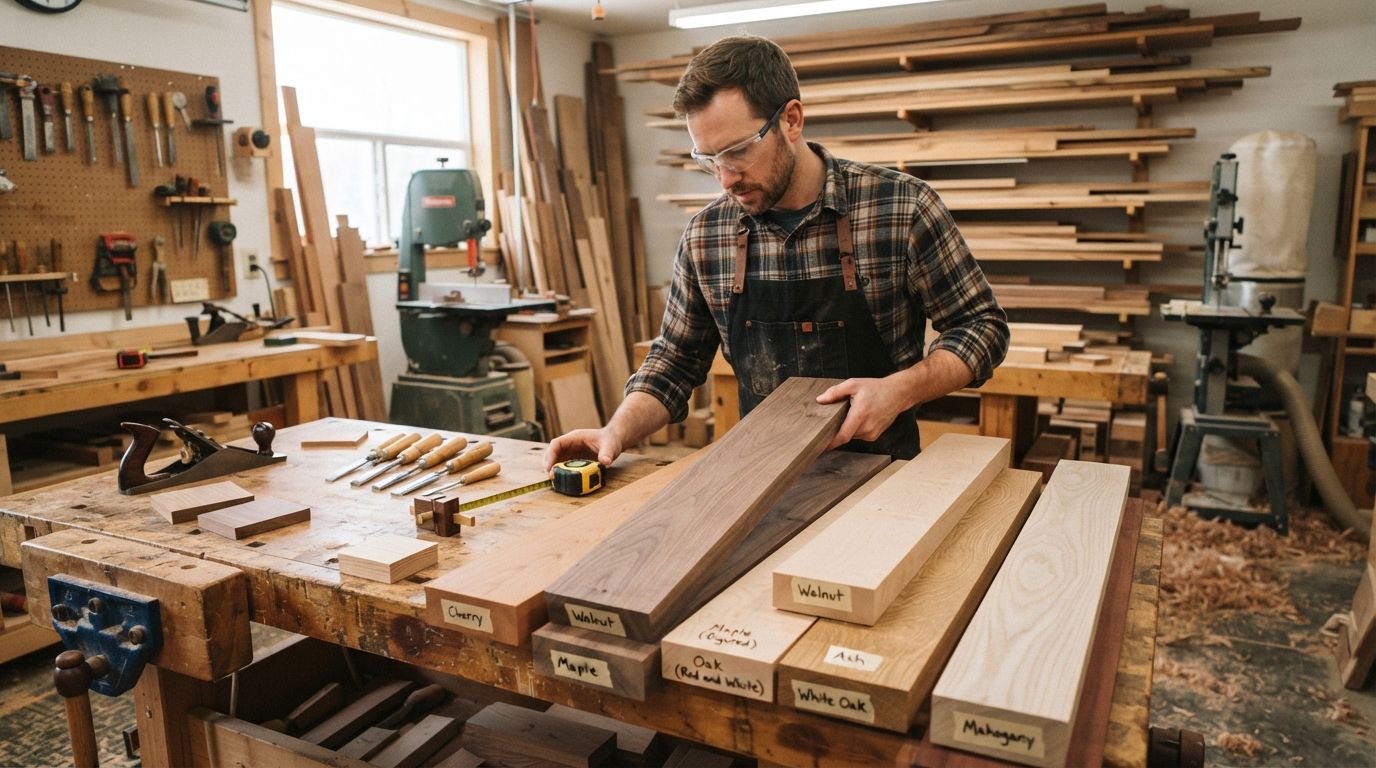
“hardwood and softwood (not correlated with hardness or softness)” — USDA Forest Products Laboratory, Wood Handbook FPL–GTR–282, Chapter 5
Quick Decision Guide
| Project Type | Prioritise | Best Choices | Avoid |
|---|---|---|---|
| Interior furniture — tabletops, chairs, floors | High Janka hardness + stability | Hard maple (1,450), white oak (1,360), ash (1,320), walnut (1,010) | Basswood, aspen, eastern white pine — dent in service |
| Interior furniture — appearance + workability | Moderate hardness, predictable grain | Walnut (1,010), cherry (950), soft maple (950) | Hickory, black locust unless you want the fight |
| Painted work, jigs, shop fixtures | Stability + low cost | Yellow-poplar (540), soft maple, MDF for flat panels | Anything you are paying a figure premium for |
| Outdoor furniture, above-ground exterior | Heartwood decay class | White oak heartwood, western red cedar, black walnut, baldcypress | Maple, birch, beech, poplar, all non-old-growth pine |
| Ground contact — posts, stakes | Very resistant class only | Black locust heartwood; otherwise pressure-treated material | Every resistant-class species — those are above-ground ratings |
| Carving + hand-tool practice | Softness + even texture | Basswood (410), butternut (490), eastern white pine (380) | Ring-porous oaks and ash — earlywood and latewood cut very differently |
| Tool handles + impact parts | Straight grain + toughness | Hickory, white ash — grain runout matters more than species | Any board with grain slope steeper than about 1 in 15 |
| First project as a beginner | Cheap, forgiving, easy to find | Yellow-poplar, eastern white pine, soft maple | Hickory, ipe, anything hard to find locally |
Hardwood vs Softwood — What the Split Actually Means
Hardwoods come from broadleaved deciduous trees. Softwoods come from conifers. The classification tells you about the tree, not the wood. The overlap between the two groups is wide enough that the label tells you almost nothing about how a board will behave under a chisel. Balsa is a hardwood at 70 lbf Janka. Longleaf pine is a softwood at 870 lbf — harder than black cherry.
A more useful mental model has three questions: How dense is it? (specific gravity — the single best index of mechanical properties) How much does it move? (tangential and radial shrinkage) Is the heartwood decay resistant? (the only property that predicts outdoor performance).
Janka Hardness — What It Tells You and What It Doesn't
The Janka test embeds a steel ball 0.444 inches in diameter into the wood until half its diameter is submerged, and records the force required in pounds-force (lbf). It directly measures resistance to denting and surface wear — and predicts very little else.
| Janka Predicts Well | Janka Predicts Poorly |
|---|---|
| Resistance to denting and surface wear | Bending strength or stiffness |
| Roughly how hard a wood is to plane and chisel | How well it takes a finish, glue, or screws |
| Comparative ranking between species | Dimensional stability (hard woods can move violently) |
| Decay resistance — no relationship at all |
The Wood Handbook reports a 20% coefficient of variation on Janka hardness. That means a species average is reliable for ranking, but any specific board can plausibly land 20% above or below its species value. The values are also measured on clear, defect-free, straight-grained specimens — not the board at your lumberyard.
Domestic Hardwoods — Ranked by Hardness
USDA FPL Table 5–3b
| Species | Specific Gravity | Janka (lbf) | Heartwood Decay Class |
|---|---|---|---|
| Aspen, quaking | 0.38 | 350 | Slightly/nonresistant |
| Basswood, American | 0.37 | 410 | Slightly/nonresistant |
| Butternut | 0.38 | 490 | Moderately resistant |
| Yellow-poplar | 0.42 | 540 | Slightly/nonresistant |
| Black cherry | 0.50 | 950 | Moderately resistant |
| Soft maple (red maple) | 0.54 | 950 | Slightly/nonresistant |
| Black walnut | 0.55 | 1,010 | Resistant |
| Birch, yellow | 0.62 | 1,260 | Slightly/nonresistant |
| Oak, northern red | 0.63 | 1,290 | Slightly/nonresistant |
| Ash, white | 0.60 | 1,320 | Slightly/nonresistant |
| Oak, white | 0.68 | 1,360 | Resistant |
| Maple, sugar (hard maple) | 0.63 | 1,450 | Slightly/nonresistant |
| Black locust | 0.69 | 1,700 | Very resistant |
| Hickory, shagbark | 0.72 | 1,880 | Slightly/nonresistant |
Domestic Softwoods — Ranked by Hardness
USDA FPL Table 5–3b
| Species | Specific Gravity | Janka (lbf) | Heartwood Decay Class |
|---|---|---|---|
| Cedar, northern white | 0.31 | 320 | Resistant |
| Cedar, western red | 0.32 | 350 | Resistant |
| Pine, eastern white | 0.35 | 380 | Mod. resistant (old-growth only) |
| Pine, ponderosa | 0.40 | 460 | Slightly/nonresistant |
| Redwood, old-growth | 0.40 | 480 | Resistant |
| Baldcypress | 0.46 | 510 | Resistant |
| Hemlock, western | 0.45 | 540 | Slightly/nonresistant |
| Douglas-fir, Coast | 0.48 | 710 | Moderately resistant |
| Pine, longleaf | 0.59 | 870 | Mod. resistant (old-growth only) |
Key Species for Woodworkers
Furniture and Cabinet Woods
Hard Maple (Sugar Maple)
The hardest common domestic furniture wood. Demanding on router bits and blades. Excellent for workbench tops where dent resistance matters. Both maple varieties blotch badly under oil-based stain — test on an offcut first. Slightly/nonresistant outdoors.
White Oak
Closed tyloses make it genuinely water-resistant — the only common domestic hardwood suitable for outdoor furniture without treatment. The standard for whiskey barrels and boat joinery for the same reason. Red oak looks nearly identical but has open tyloses and decays outdoors in 2–5 years. Full cedar vs oak comparison →
White Ash
The best domestic wood for impact absorption. Chair legs, baseball bats, axe handles — wherever the Wood Handbook's straight-grain rule matters most. At a grain slope of 1 in 10, impact resistance falls to 62% while compression stays at 99%. Grain runout causes the handle failure, not species choice.
Black Walnut
Unusual combination: only moderately hard, yet as strong in bending as white oak (14,600 vs 15,200 lbf/in² MOR) and in the resistant decay class. Works easier than its strength suggests. The premium price is for the figure and colour, not the mechanical properties.
Black Cherry
Moderate in every mechanical property — the consistency is much of its appeal. Machines and hand-works predictably. Moderately resistant to decay (better than maple or birch, not as good as walnut). Significant colour change on UV exposure — finishes dramatically darker over the first year.
Soft Maple (Red Maple)
A genuine furniture hardwood at close to utility-wood prices. Identical hardness to black cherry at one-third to one-half the cost. Blotches badly under stain — paint it or go for a film finish. Often the better choice for drawer sides, cabinet backs, and face frames.
Outdoor and Decay-Resistant Woods
The USDA FPL is explicit: untreated sapwood of essentially all species has low resistance to decay. Buying “cedar” means nothing if the board is sapwood. For any outdoor application, specify heartwood — and understand which class of resistance you actually need.
| Species | Decay Class | Ground Contact? | Notes |
|---|---|---|---|
| Black locust | Very resistant | Ground contact suitable | Dense (1,700 lbf), invasive in eastern US — sometimes free from local sawmills |
| Western red cedar | Resistant | Above-ground only | Lightweight, aromatic, very stable (1.9% radial shrinkage). Special OSHA dust warning — lowest dust exposure limit of common species at 0.5 mg/m³ |
| White oak (heartwood) | Resistant | Above-ground only | The only common hardwood with closed tyloses — physically blocks water penetration |
| Black walnut | Resistant | Above-ground only | Uncommon for outdoor use given the price, but genuinely durable |
| Baldcypress (old-growth) | Resistant | Above-ground only | Young-growth baldcypress is only moderately resistant — grade matters |
| Redwood (old-growth) | Resistant | Above-ground only | Young-growth redwood drops to moderately resistant |
| All other pine / spruce / fir | Slightly/nonresistant | Protect or treat | Modern lumberyard pine is not old-growth — treat as nonresistant regardless of species name |
See: What Wood Doesn't Rot Outdoors · Teak vs Cedar vs White Oak for outdoor furniture
Best Woods for Beginners
Three species cover most first projects, and there is a reason each keeps appearing on beginner lists.
| Species | Janka (lbf) | Why It Suits a Beginner | What to Watch |
|---|---|---|---|
| Yellow-poplar | 540 | Cheap, widely stocked, cuts and sands easily, stable, takes paint beautifully | Green/purple streaking makes it poor for clear finish. Not decay resistant. |
| Eastern white pine | 380 | The softest common wood that still holds a joint. Most forgiving for hand tools — planes, chisels, spokeshaves all work easily | Dents easily. Knots are common — both weak points and tearout hazards around them. |
| Soft maple (red maple) | 950 | A genuine furniture hardwood at close-to-utility-wood prices. Machines cleanly. Good for first real furniture | Blotches under oil stain. Harder on cutting edges than poplar or pine. |
The mistake that isn't about species: Buying wood at the wrong moisture content causes more first-project failures than wrong species choice. A panel glued at 12% MC in a shop and moved to a heated house at 30% RH will head toward 6% MC — and shrink the whole way. Sticker the boards in the room where the piece will live, wait 1–2 weeks, then cut joinery. OSU Extension EM 8600
Sheet Goods — Plywood, MDF, and Particleboard
Panel products solve the movement problem that solid wood creates. Cross-banded veneers and randomly oriented fibers move far less than a solid board of the same width.
| Panel | What It Is | Strengths | Limitations | Best For |
|---|---|---|---|---|
| Hardwood plywood | Veneer layers over various cores | Highest strength and stiffness per weight. Holds screws in the face. Stable. | Edge treatment required. Face veneer sands through easily. Core quality varies enormously by grade. | Cabinetry, furniture backs and sides, shop jigs |
| MDF (medium-density fiberboard) | Resinated cellulosic fibers, pressed flat | Perfectly flat, no grain, crisp machined edges. Best substrate for paint and veneer. | Heavy. Poor screw holding in the edge. Swells irreversibly when wet. Produces very fine dust. | Painted cabinet doors, router templates, flat panels |
| Particleboard | Cellulosic particles pressed with resin | Cheapest and flattest. Adequate under laminate or veneer. | Weakest of the three. Poor fastener holding throughout. Least moisture tolerant. | Substrate under countertop laminates |
Federal formaldehyde law: Since March 2019, all composite wood products sold in the US must be TSCA Title VI compliant and labeled as such. Limits: hardwood plywood 0.05 ppm, particleboard 0.09 ppm, MDF 0.11 ppm (ASTM E1333-10 test method). Products with NAF (no-added formaldehyde) or ULEF resins qualify for limited exemptions. EPA 40 CFR §770.10
Wood Movement — The Most Underestimated Factor
More finished projects fail from moisture movement than from any strength deficiency. Wood shrinks and swells only below the fiber saturation point (about 25–30% moisture content) — above it, wood gets heavier but no larger. Every percent of moisture content change below the FSP changes the dimensions.
For heated interior use, target 7% MC. For exterior construction framing, below 20% MC. A kiln-dried board at the lumberyard picks up or loses moisture in transit, in the yard, and in your shop — it is rarely at 7% when you buy it. OSU Extension EM 8600
| Relative Humidity | Equilibrium MC | Typical Application |
|---|---|---|
| 10–20% | 2–4% | Bone dry heated interior (desert, winter heat) |
| 30–40% | 6–8% | Typical heated interior, winter |
| 50–60% | 9–11% | Interior, moderate humidity |
| 70–80% | 12–16% | Exterior sheltered / coastal interior |
| 90% | 20–21% | Near-saturated / outdoor exposure |
Quartersawn vs flatsawn: Tangential shrinkage (along the growth rings) runs roughly double radial shrinkage (across the growth rings). A flatsawn board moves at close to the tangential rate across its width; a quartersawn board moves at roughly half that. For wide tabletops, drawer fronts, and panels captured in frames, quartersawn stock halves the movement you design around. This is a structural choice, not just a decorative one. OSU Extension EM 8600
Wood Dust Safety
| Body | Limit | Basis | Status |
|---|---|---|---|
| OSHA Permissible Exposure Limit | 15 mg/m³ total; 5 mg/m³ respirable | 8-hour TWA | Enforceable |
| NIOSH Recommended Limit | 1 mg/m³ total | 8-hour TWA | Recommended only |
| ACGIH TLV — Western red cedar | 0.5 mg/m³ | 8-hour TWA | Set for asthma, not cancer |
- Capture dust at the source — a tool without dust collection puts the highest concentration directly in your breathing zone
- Sanding and MDF machining produce more respirable particulate than sawing and it stays airborne longest
- Sensitization can develop at any point; a species worked comfortably for years can start producing reactions
- Use at minimum an N95 respirator; P100 (99.97% filtration) for hardwoods and MDF