Bottom Line: Ultimate Small Shop is a legitimate $29 PDF guide — 246 pages of real small-workshop content covering layout, tools, and shop setup. The core advice is solid. But three marketing claims don't fully hold up under scrutiny, and we explain exactly where each one breaks down below.
Most online reviews of Ultimate Small Shop are written by affiliates who get paid when you buy. That creates an obvious conflict. We read the full guide, stress-tested the three headline claims against real-world numbers, and wrote this review from what we found — not from what earns the most commission.
What You're Actually Buying
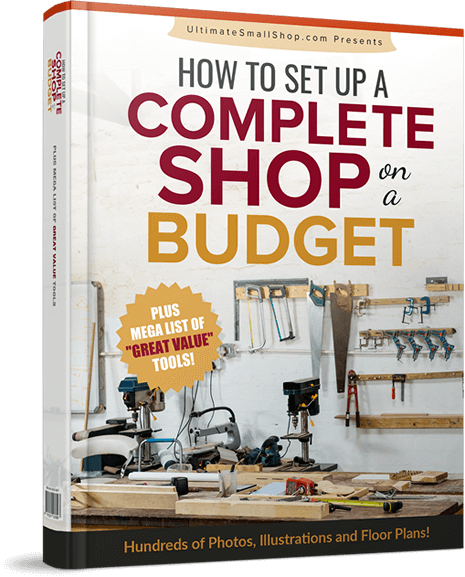
Ultimate Small Shop is a 246-page PDF guide focused on setting up a functional woodworking shop in a small space — typically a one-car garage or spare room. It covers six topic areas:
| Module | What it covers |
|---|---|
| 1 — Tool Selection | Which tools to buy first, hand tools vs power tools, what to skip |
| 2 — Space Selection | Evaluating garages, basements, sheds — pros and cons of each |
| 3 — Layouts | Floor plan options for different square footage ranges |
| 4 — Electrical, Lighting, Soundproofing | Circuit requirements, LED upgrades, basic acoustic treatment |
| 5 — Heating, Cooling, Ventilation, Dust | Shop heater options, dust collection routing, air filtration |
| 6 — Safety | Fire safety, first aid, workflow habits |
The bonuses include a "Workshop Cheat List" (a quick-reference card of tool specs and settings) and a "Deal Alert Service" that notifies you of tool deals — though the latter is more of a curated email than an active monitoring tool.
Testing the Three Big Claims
The sales page makes three specific claims. Here's what actually holds up.
What the guide says: You can build a functional woodworking shop for under $1,000 in tools.
What we found: A hand-tool-only setup (chisels, hand saw, planes, drill) runs roughly $296 new — well under $1,000. A mid-tier power tool shop bought used can hit the $1,000 mark if you're patient. But a realistic beginner shop with a table saw, miter saw, drill press, and basic power tools runs $1,200–$2,500 even buying used, based on independent estimates from woodworking communities.
The catch: The $1,000 figure depends entirely on how you define "complete." If complete means hand tools plus a drill, it's achievable. If complete means having a table saw, the claim doesn't hold for most buyers.
What the guide says: The book includes a 10×6 foot (60 sq ft) layout for a complete workshop.
What we found: A 4×8 sheet of plywood covers 32 sq ft — more than half the floor. Fixed equipment (workbench, tool storage, drill press footprint) takes up roughly 32.5 sq ft. To rip a full sheet on a table saw, you need at least 8 feet of infeed and 8 feet of outfeed clearance — 18.5 feet total — which can't happen in a 10-foot room.
The catch: The 10×6 layout works for hand tools and for breaking down sheet goods with a track saw (which doesn't need infeed/outfeed room). The guide does acknowledge this. But the marketing implies a "complete" shop, which most woodworkers would assume includes a table saw. That assumption breaks the layout math.
The fix the guide recommends: A track saw instead of a table saw for sheet goods — actually a reasonable small-shop solution, and one of the better pieces of advice in the book.
What the guide says: Buyers can access woodworking suppliers offering up to 70% off retail prices.
What we found: The guide points to used tool markets (Craigslist, Facebook Marketplace, estate sales) and recommends buying previous-generation models. These strategies do produce real savings — 40–60% off retail on used tools is common. But we couldn't verify a structured "supplier discount" program delivering 70% off to guide buyers specifically.
The catch: The savings are real if you shop smart. But they're not exclusive to buying this guide — anyone can buy used tools. Don't buy this expecting an exclusive discount code or supplier relationship.
What the Guide Gets Right
Despite the overreach in the marketing claims, the actual content inside has real value for first-time shop builders:
- Buy order that makes sense: The guide recommends a sensible tool acquisition sequence — measuring tools → drill → circular saw → workbench → sander → miter saw → router → table saw last. This is genuinely good advice. Most beginners buy a table saw first and then realize they can't safely use it without a proper workbench and support tools.
- Track saw as a table saw alternative: For small shops, a track saw (or circular saw with a straightedge) for sheet goods is legitimately better than cramming a table saw in. The guide makes this point clearly.
- French cleat walls: The section on French cleat wall storage is practical and well-explained — one of the best small-shop storage solutions and often overlooked by beginners.
- Mobile bases: The recommendation to put major equipment on locking casters to reconfigure the shop for each project is solid small-shop thinking.
- Electrical planning: The section on circuit requirements before buying tools (a table saw needs a dedicated 20A circuit) is exactly the kind of planning beginners don't do but should.
- Cast iron used vs. new contractor-grade: The advice to buy older cast-iron tools used rather than new contractor-grade is well-founded — a used 1970s Delta table saw outperforms a new $400 contractor saw in most respects.
- Dust collection before power tools: Prioritizing dust collection early is genuinely important for health and the guide makes that case well.
Is It Worth $29?
| Situation | Worth it? | Why |
|---|---|---|
| First-time shop builder, overwhelmed by where to start | ✅ Yes | The structured walkthrough is worth $29 in saved decision fatigue alone |
| Short on time, want a done-for-you layout plan | ✅ Yes | Beats researching everything from scratch; 60-day refund limits the risk |
| Short on money, hoping this saves you $1,000 on tools | ❌ No | The savings are real but not exclusive; spend the $29 on tools instead |
| Already have a shop set up | ❌ No | Most of the value is in the initial setup phase |
| Expecting a structured video course | ❌ No | It's a PDF — text and diagrams, no video |
Who Should Buy — and Who Shouldn't
✅ Buy it if you are…
- Setting up your first shop and don't know where to start
- Working with a garage, basement, or spare room under 400 sq ft
- Looking for a structured plan rather than piecing together YouTube advice
- OK reading a PDF — no video content
- Comfortable with a 60-day refund window to decide
❌ Skip it if you are…
- Expecting a video course or interactive content
- Hoping the guide will unlock exclusive supplier discounts
- Planning a dedicated large shop (600+ sq ft)
- Already set up and looking for advanced technique guides
- Tight on cash and viewing $29 as a tool budget
Our Score
The guide earns its score from genuinely useful content undercut by marketing claims that oversell what the product delivers. At $29 with a 60-day refund, the risk is low — but go in knowing what you're buying.
Get Ultimate Small Shop — $29 + 60-Day Guarantee →How the Refund Works
ClickBank handles the transaction, which means the refund process is straightforward and enforced by the platform — not just by the vendor's goodwill.
- Keep your order number from the purchase confirmation email
- Read the guide within the 60-day window — enough time to evaluate whether it's useful for your specific situation
- If it's not what you wanted, request a refund directly through ClickBank's customer support portal
- Full refund, no questions asked
The 60-day window is genuinely useful here — long enough to actually set up part of your shop and see whether the advice applies to your space.
The Best Advice from the Guide (Free)
If you're not going to buy the guide, here are the most actionable points that don't require purchasing anything:
- Track saw first, table saw later. For sheet goods in a small shop, a circular saw with a straightedge or a track saw beats a table saw on space, safety, and flexibility. You don't need 18+ feet of clearance for a circular saw.
- Buy tools in this order: tape measure + combination square → drill/driver → circular saw → workbench → random orbit sander → miter saw → router → table saw (if ever). Each tool enables the next.
- Buy used cast iron, not new contractor grade. A 1970s Rockwell Delta Unisaw costs $300–$600 used and outperforms a $400 new contractor saw. The old iron is heavier, more stable, and more accurate.
- French cleat walls beat fixed shelving. A 4×8 sheet of ¾" plywood ripped into 30° strips creates infinitely reconfigurable tool storage. Cost: ~$40 in materials.
- Mobile bases on everything. Locking casters on your major equipment let you reconfigure for the cut — push the table saw to the door for long rips, back to center for crosscuts.
- Check the circuit before you buy the tool. A table saw needs a dedicated 20A 240V circuit. Running it on a shared 15A household circuit will pop breakers constantly and risks a fire.
- LED lighting over fluorescent. 5000K LED shop lights cost $30–$60 each, render color accurately, and don't flicker. Accurate color matters when matching wood grain and finishing.
- Shop vacuum + cyclone separator beats a dedicated dust collector under 400 sq ft. A $30 cyclone separator on a $60 shop vac handles 95% of shop dust in a small space without a permanent installation.
Frequently Asked Questions
Partially. A hand-tool-only setup can reach ~$296 in tools. But a mid-tier shop with a table saw, miter saw, and drill press realistically runs $1,200–$2,500+ even buying used. The $1,000 figure holds only if you define "shop" very narrowly as hand tools plus a drill.
For hand tools and a track saw, yes. For a table saw, no — you need 18+ feet of infeed/outfeed clearance to rip a sheet of plywood, which doesn't fit in a 10-foot room. The guide recommends a track saw solution for small spaces, which is actually good advice.
No. The product exists, the content is real and detailed, and ClickBank's 60-day refund backs it. Some marketing claims are overblown, but the guide itself is legitimate and covers real small-shop setup topics.
Ralph Chapman is the author, presented as a long-time woodworker who built multiple small workshops. The guide draws on his experience setting up functional shops in tight spaces.
60-day money-back guarantee through ClickBank. Keep your order number from the purchase email, request within the window, and you get a full refund with no questions asked.
If you're setting up your first small shop and want a structured guide, yes — $29 is low-stakes with a 60-day refund. If you're hoping it helps you save $1,000 on tools, the savings are real but not exclusive to buying the guide.